
Growing White Button Mushrooms: A Beginner’s Guide to Small-Scale Success
Growing White Button Mushrooms: A Beginner’s Guide to Small-Scale Success
Transparency Disclosure: This article is prepared using authentic, verified sources to ensure accuracy and reliability. This post also contains affiliate links. If you make a purchase through them, we may earn a small commission at absolutely no extra cost to you. As an Amazon Associate, I earn from qualifying purchases.
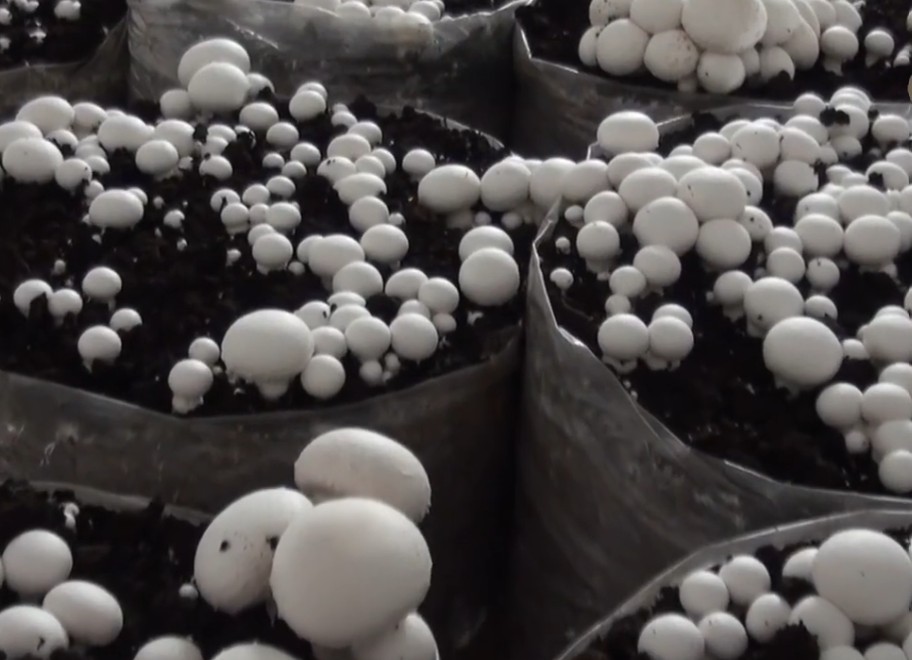
SIX STEPS OF CULTIVATION
- Production or procurement of spawn
- Preparation or procurement of compost
- Spawning
- Casing
- Production of crop.
- Marketing.
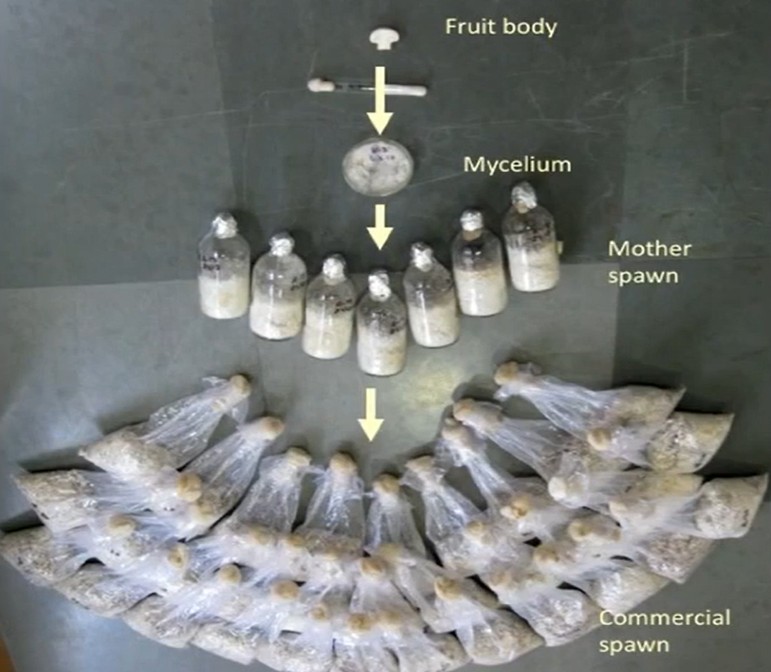
SPAWN
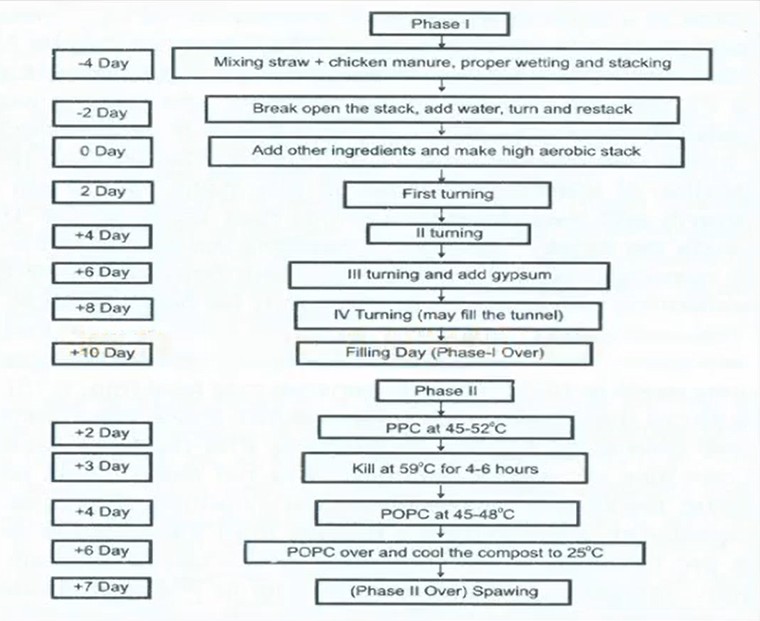
COMPOST PREPARATION
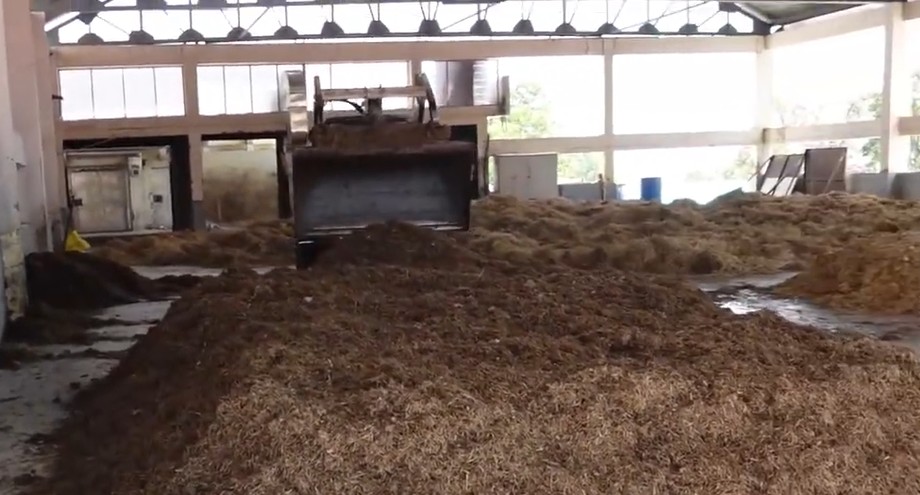
The compost is prepared with long method and short method of composting.
MATERIAL REQUIRED FOR LONG METHOD OF COMPOSTING FOR WHITE BUTTON MUSHROOMS
Wheat straw or Paddy straw 300 Kg
Wheat bran 15 Kg
CAN 9 Kg
Urea 3 Kg
Superphosphate 3 Kg
Muriate of Potash 3 Kg
Gypsum 3 Kg
Or
Wheat straw 300 Kg
Wheat bran 21 Kg
Cotton seed cake 12 Kg
Urea 7 Kg
Gypsum 15 Kg
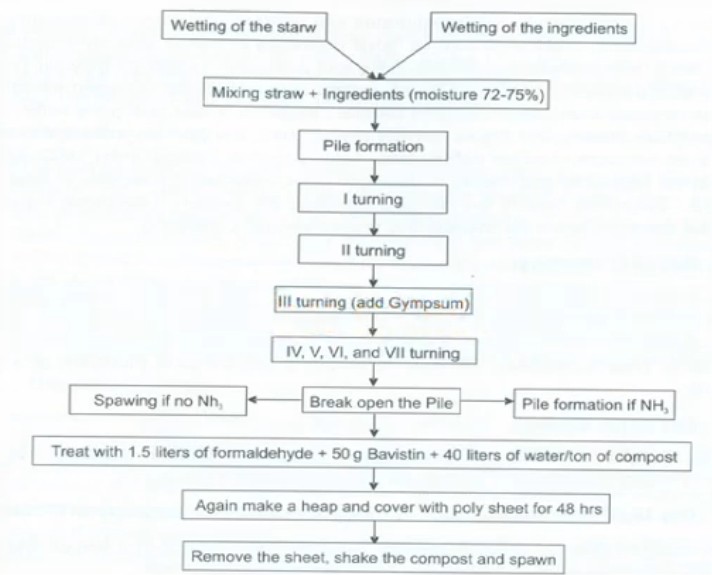
MATERIAL REQUIRED FOR SHORT METHOD OF COMPOSTING IN WHITE BUTTON MUSHROOMS
Wheat straw 1000 Kg
Chicken manure 400 Kg
Wheat bran 70 Kg
Urea 14.5 Kg
Gypsum 30 Kg
After spawn preparation, 10 Kg spawn is filled up to the height of 30 cm in Spawn Bag of Size 24 X 22 Inches.
TIME OF GROWING IT NATURALLY
The white button mushrooms production starts from October month Up to February End, when it grows under natural condition. It requires 15 -20 Degree Celsius temperature for fruiting and 24 Degree Celsius for 7 days before fruiting. If temperature is below 15 Degree, the heater or blower can be used to increase the temperature. If temperature high, water can be sprinkled and cooler can be used to decrease the temperature by blowing air. For growing the tropical mushroom i.e. White Milky Mushroom, the required temperature is 30-40 Degree C.
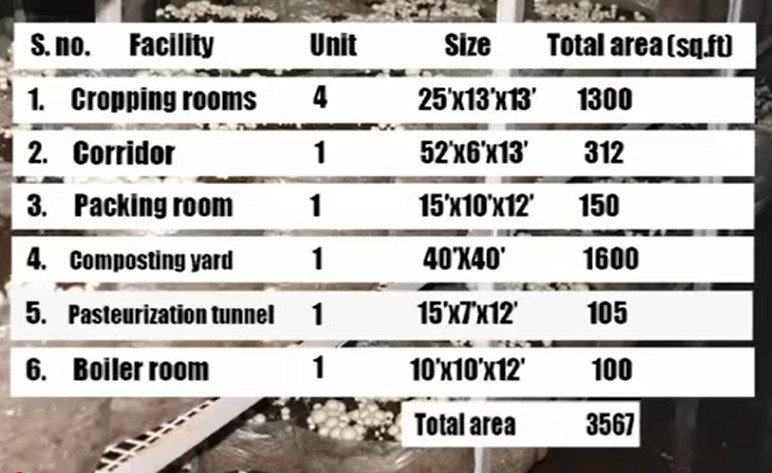
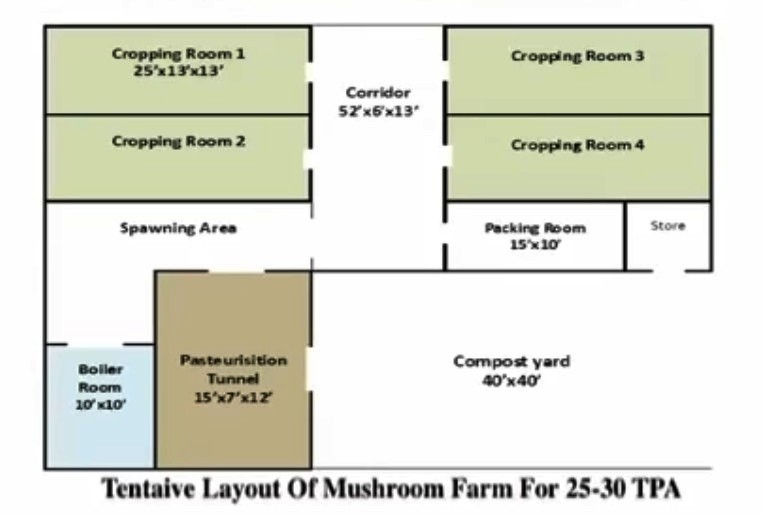
CROPPING ROOM
Dimension for cropping room approved by DMR Solan, HP is 60 X 20 X 13 feet and 11 Ton AC is required to cool the room with above dimensions.
CONDITION FOR GROWING
- White button mushrooms grow well in dark. It means it does not require direct sun light.
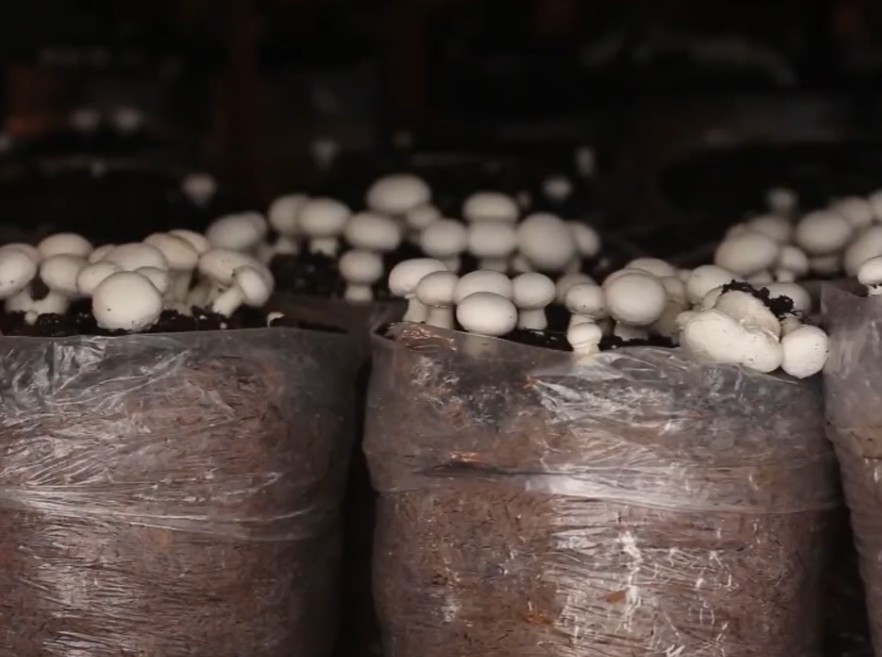
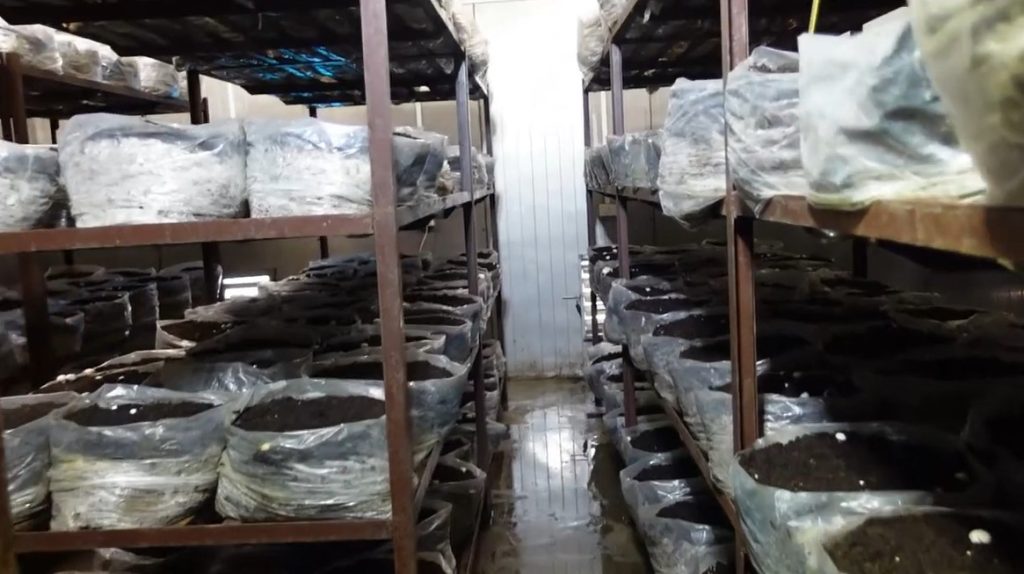
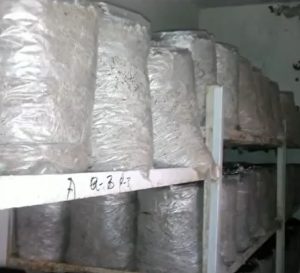
- Keep the bags in growing room and close the room completely for 10 – 15 days at 25-27 Degree C + 85 – 90 percent humidity. It produces Carbon dioxide (more than 10,000 ppm) and it will help in white mycelial growth in the bags.
- After 10 days when white mycelial growth spreads properly. It is also called spawn run. Roughling is important for uniform growth of mushroom. Roughling is breaking of top layer of white mycelial growth.
- On 11th and 12th day casing with 1.5 inch thick layer cocopeat on top is done for maintaining 50-60% humidity. The cocopeat should be sterilized with formalin + insecticide. Gypsum can also be added in cocopeat.
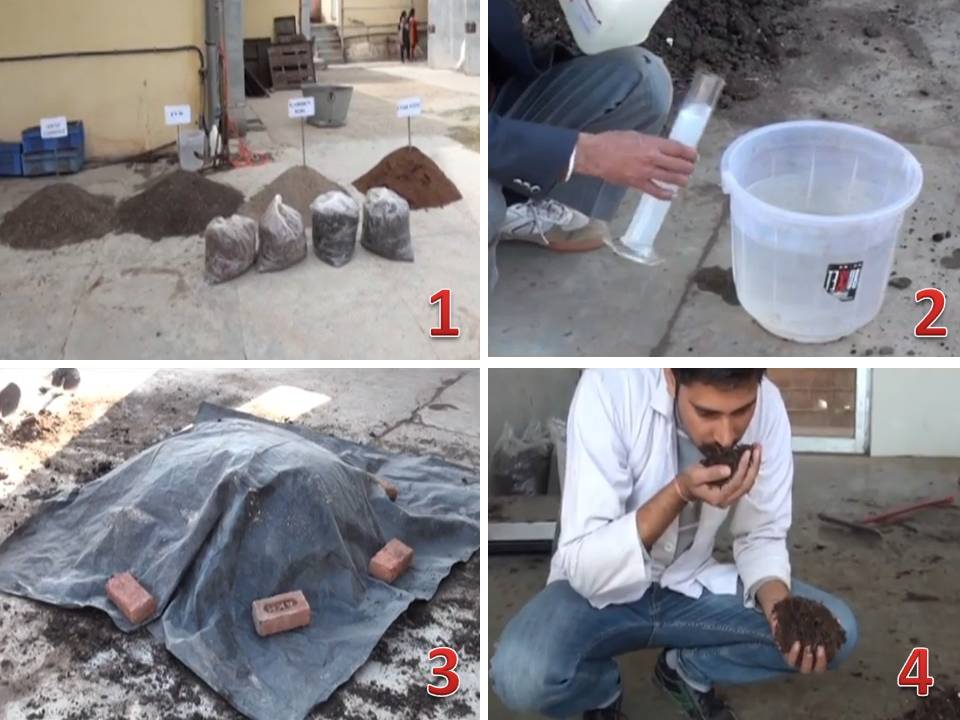
If soil is being used as casing, then casing soil is treated either by steam at 65-70 °C for 6-8 hrs, or by drenching with formaldehyde or formalin (40%). Make a heap of casing material on cemented floor and wet it thoroughly. Make a solution with formalin @ 2 Litres dissolved in 40 Litres of water and drench the heap thoroughly. Cover it with polythene sheet and seal its outer periphery properly with brick and soil / sand. Keep it for 5 – 6 days under the sun for proper sterilization. After that, turn the material properly to remove the formalin traces. or casing soil should be pasteurized at 65 degree Celsius for 6 – 8 hours by steam in pasteurization chamber, made for this purpose. After cooling it to 25 degree Celsius, it is ready for application. The pH of casing soil is adjusted between 7-8 with the addition of chalk powder (calcium carbonate)
- There are other formulations of casing soil :
a) Mixture of 2 years old FYM and 2 years old spent compost (1:1, v/v)
b) Garden soil and sand mixture (4:1 by volume)
c) Decomposed FYM and loam soil (1:1 by volume)
d) Decomposed Coir pith and burnt rice husk (3:1)
e) Decomposed FYM and burnt rice husk (3:1)
- After casing, spray water immediately, but it should not travel to the compost and keep it, for at least one week at 23 – 25 degree Celsius and Carbon dioxide at 10,000 ppm, so that the white spawn travel to the casing soil. Spray the water daily and maintain the relative humidity 95 percent.
- The temperature should be reduced to 15 – 17 degree C, relative humidity 85 percent and Carbon dioxide 800 to 1000 PPM. Fresh Air is important for growing.
- Watering should be done very carefully to avoid water logging conditions. Check water with squeezing the top layer coco peat with tight hand. Water should not come on squeezing.
- The air inside the production room should be changed 4 – 6 time in hour, to maintain the CO2 concentration.
HARVESTING AND AFTER CARE
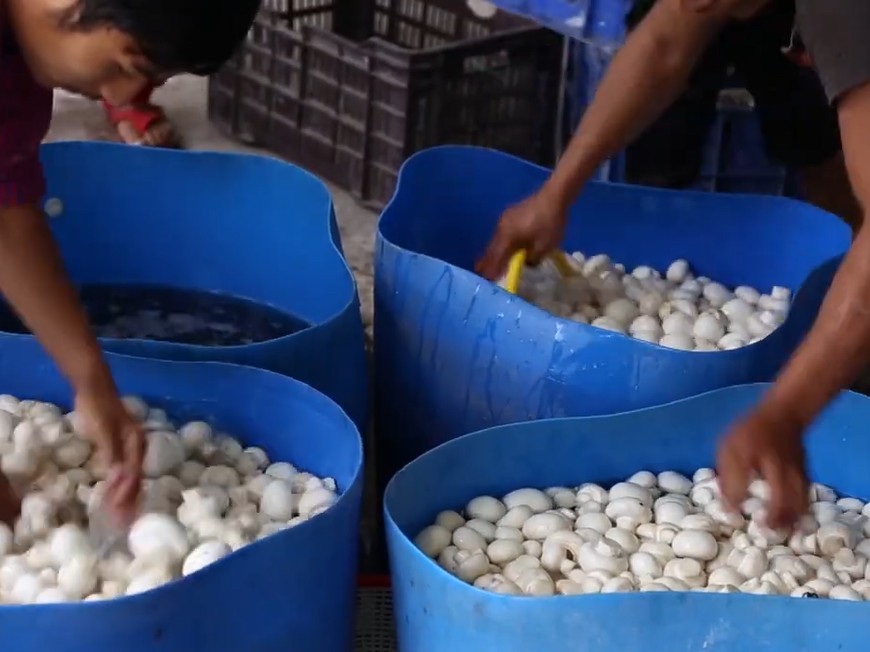
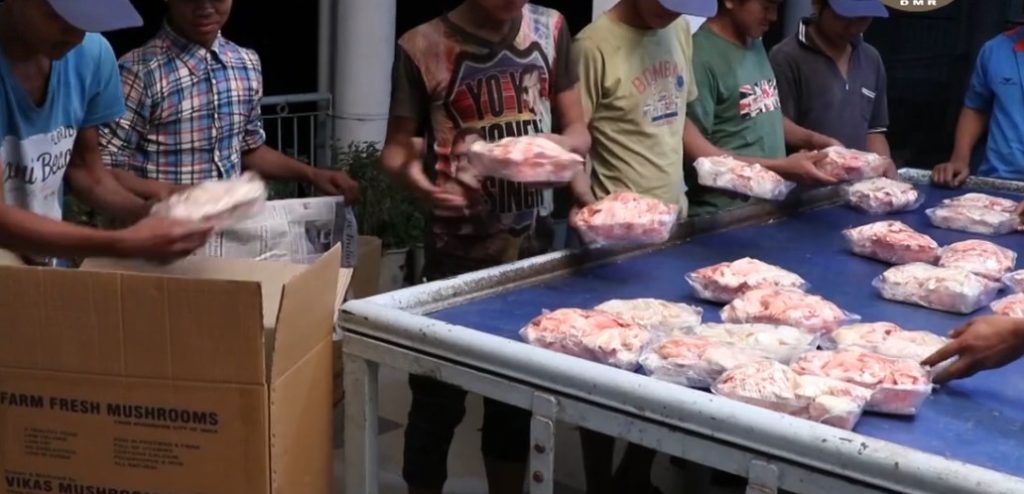
- Harvesting of white button mushrooms starts after 30-32 days. Mushrooms with 1 – 1.5 inch thickness are ideal size for harvesting. This size mushroom has good shelf life in market. Only 8- 10 mushroom should come in 200 gm pack.
- 1 Bag :- 2 – 2.5 Kg Mushroom Production.
- Life of one bag of compost is 3-4 month for naturally ventilated growing unit and it is one month for growing in controlled condition with AC. The life is less in AC room due to fast production.
- The material of used compost bag can be used as good manure in the agriculture farm.
SHED COST
Mushroom shed of size 33 x 66 Ft with 12 foot height from centre and 8-10 Foot from sides with the use of locally available material the cost comes to 1 Lakh rupees and for Racks and other expenditure 1- 2 Lakhs is required.
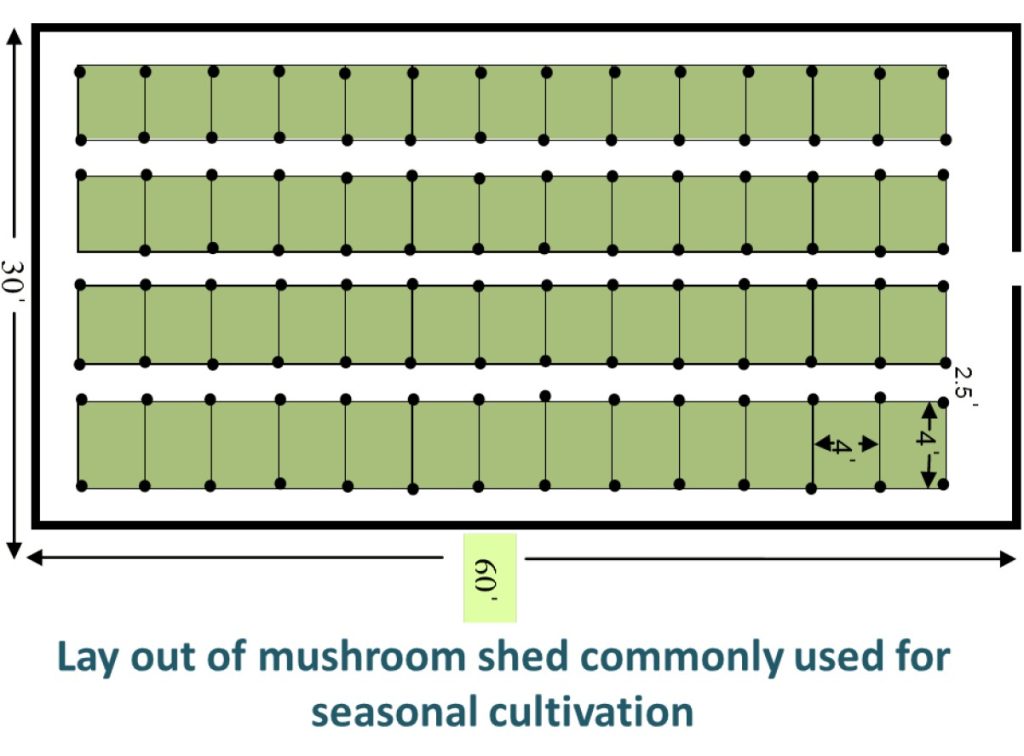
For white button mushrooms, cropping room with size of 16 x 65 ft Length and Width is required, it can accommodate 7 racks in 16 ft height (Each 2.5 foot wide) for keeping the 3000 bags at a time.
DISEASES IN WHITE BUTTON MUSHROOMS
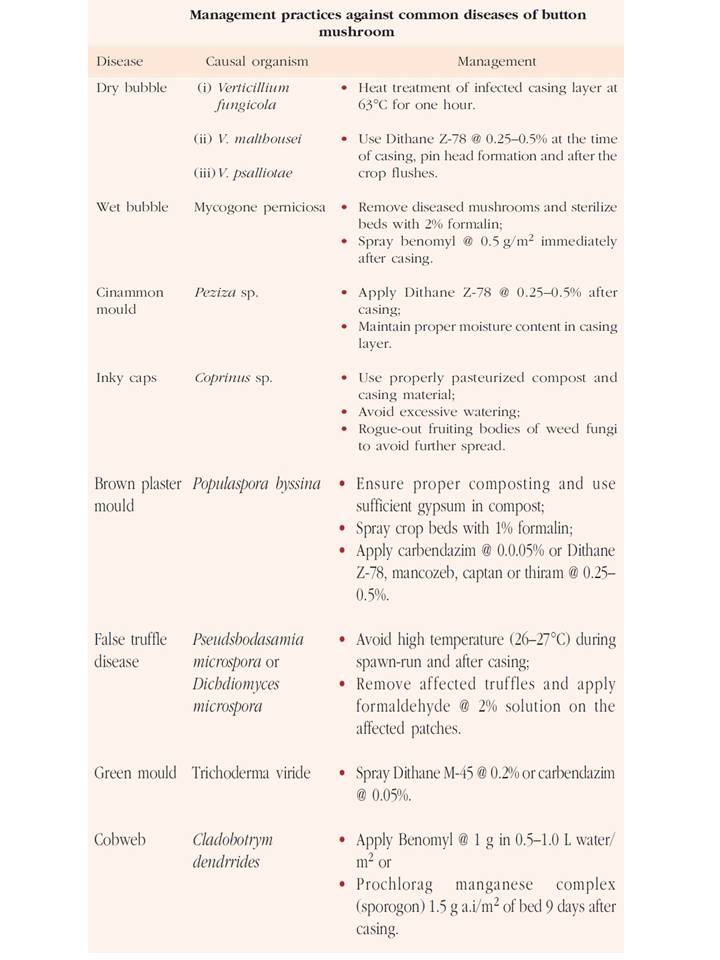
Wet bubble: In this disease, the development of distorted masses of mushroom tissues occur, which initially are white and fluffy but become brown with age and then decay.
Dry bubble: Small pimple like out-growth from the top of cap or blue grey spots (1–2 cm dia.) on the cap surface. Such spots often have yellow or bluish-grey halo around them.
Cobweb disease: It is called as cobweb disease because the disease exhibits characteristic coarse mycelial growth over the affected mushroom. The pathogen rapidly colonizes mushroom which eventually turns brown and rots. The mycelium colour of pathogen changes to pink or red and the cobweb appearance is replaced by a mycelial mat. Brown or pink-brown spots with poorly defined edge are associated with the disease.
Green mould:
- Proper sanitation and maintaining hygienic conditions are primary requirements for successful mushroom production. Keep away all the materials which may help in the establishment of pathogenic organisms/insect-pests in mushroom production chain. The
- mushroom production rooms and trays should be sterilized with 2% formaldehyde solution after every crop;
- Use clean water for wetting the straw during compositing;
- Prepare compost under roof cover and turning of compost should be in such a manner that the whole pile gets decomposed otherwise there is every apprehension that any under composed material left in pile may harbour pathogenic organisms/pests. Improper decomposition also hampers the spawn-run and mushroom development.
- Maintain proper moisture content in compost. High or low moisture content in compost may favour development of unwanted fungi.
- Don’t prepare compost directly on bare soil surface. It should be prepared either on cemented or puka floor.
- Pasteurize and condition the compost properly so that pathogenic inoculums and other pests are eliminated.
- Maintain proper temperature and relative humidity during spawn run and casing. It ensures optimum production of mushrooms and also restricts the growth of unwanted fungi.